**This is an old revision of the document!**
Complementary Metal-Oxide-Semiconductor (CMOS) Sensor
Working Principle
This image shows how a photodector works. The photon penetrates the silicon and create a electron-hole pair connection. The photonic penetration depth on silicon, i.e., the light absorption, depends on the wavelength. This means that the longer the wavelength λ [m] of a photon, the loweris its energy, and the further it can delve into silicon. 1)
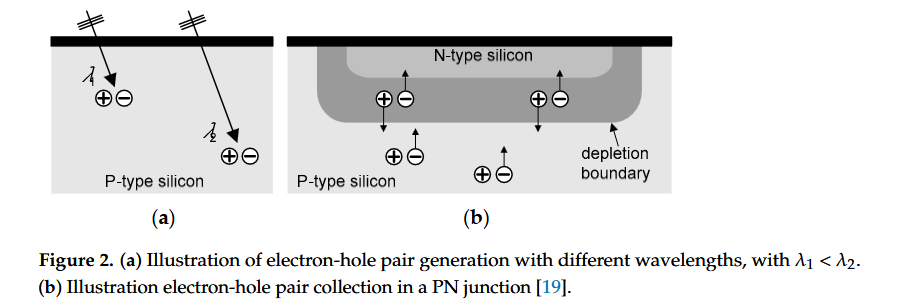
Silicon photodetectors can create photogenerated currents for impinging light with wavelengths across the complete visible range. The produced photocurrent is proportional to the intensity of the incident light and is given by :
$$I_{ph} = \frac{e \times QE \times \lambda \times P_i}{hc} = \frac{e \times QE \times P_i}{hv}$$
where Iph [A] is the photocurrent, e [C] is the elementary charge, λ [m] is the wavelength of the incident light, QE [%] is the quantum efficiency, Pi[W] is the incident optical power, h [J.Hz−1] is Plank’s constant, and c [m.s−1] is the velocity of light in a vacuum. The quantity $E = \frac{hc}{\lambda} = h\nu$[eV] is the energy of a photon and ν [Hz] is the frequency of the photons. Formally, the quantum efficiency is determined by the ratio of the generated electrons Ne<\sub> to the incident photons N<sub>ph within the photodetector :
$$QE = \frac{N_e}{N_{ph}} = \frac{\left(\frac{I_{ph}}{e}\right)}{\left(\frac{P_i}{h\nu}\right)} = R \times \left(\frac{h\nu}{e}\right)$$
where R [A/W] is the responsivity of the photodetector. Responsivity is very important because it relates the generated photocurrent Iph [A] with the impinged optical power Pi [W], e.g., R = Iph/Pi [A/W]. Hence, after acquiring the photocurrents, the primary physical quantity that was obtained is the responsivity. Subsequently, the quantum efficiency is derived from Equation (2)
Discussion