Warning: Trying to access array offset on null in /home/clients/973fd5e0710b7a5b5f1f969d927970d7/sites/lib.naknow.eco/lib/plugins/latexcaption/syntax/reference.php on line 74
Manufacturing processes of multilayer Printed Circuit Boards (PCB)
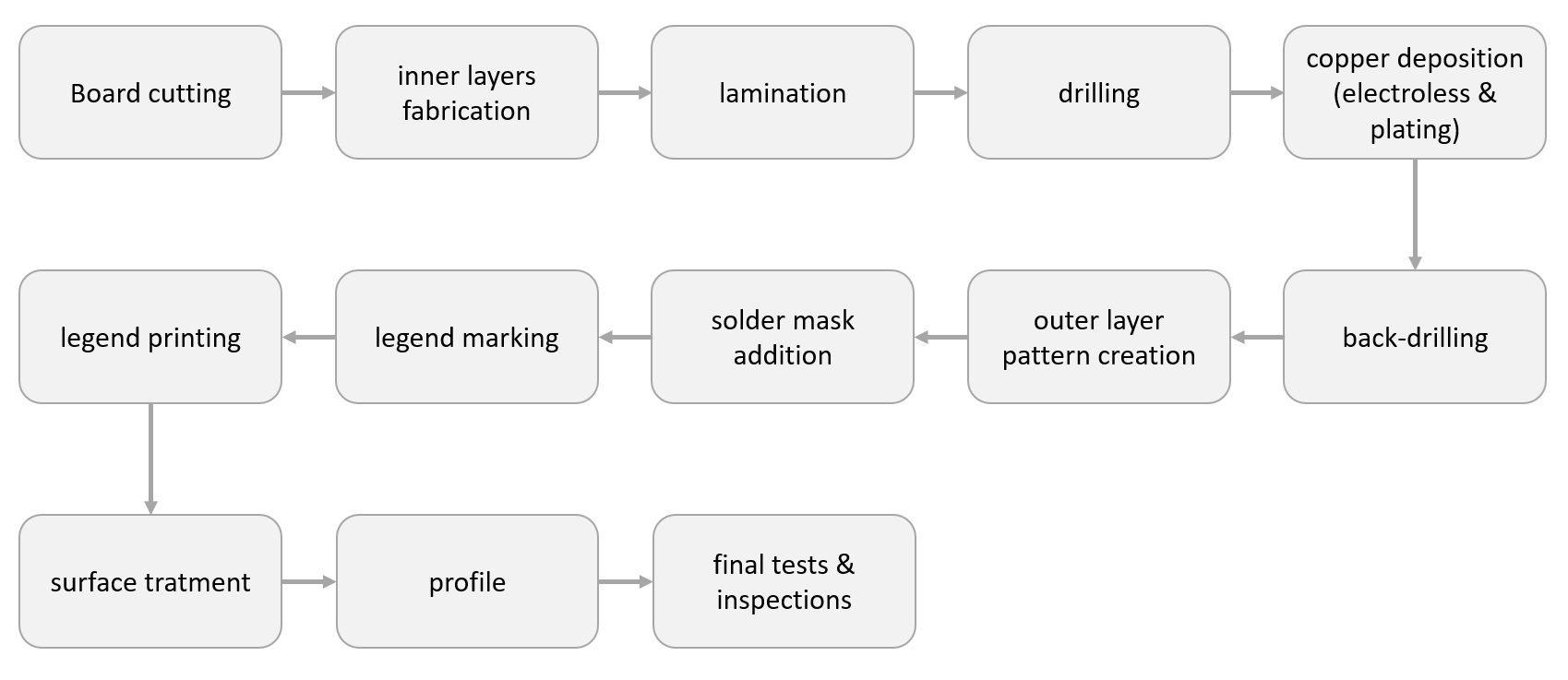
This page aims to explain the manufacturing process flow of multilayer PCB manufacturing. Figure 1 gives an overview of this flow. It is important to note that this flow is adapted depending on the type of PCB (single sided, double sided, or multilayer).
-
1. Board cutting
The substrate and copper boards are cut and their edges are soften.
-
2. Inner layer printing and etching
2.1 Pre-treating
During this step the Copper Clad Laminate (CCL) sheet is cleaned to remove any impurities and to roughen (slighlty) its surface. The roughening of the surface is important to ensure a good adhesion of the photosensitive film that will be applied during the next process step. Chemicals (acidic solution) are used for the surface roughening. Once the roughening is done, the board is dried to stop evenly the roughening process.
2.2. Dry photosensitive film lamination
Once the surface is prepared, a photosensitive film is applied onto the panel. This is done through a lamination machine that laminates a liquid photoresist stucked in between two PET and a PE films. The lamination is usually processed in a cleanroom environment, meaning a room with controlled atmosphere and temperature.
2.3. UV ray exposure
During this step the circuit design is transfered onto the photosensitive film. There are two methods to do so:
- exposing all the photosentive film to UV rays through a mask that has the wanted circuit design,
- by laser direct imaging: the lasers expose the photosensitive film to UV rays by drawing the desired pattern that maches the wanted circuitry. Therefore, no mask is needed.
The panel is now constituted of the CCL sheet on top of which the photosensitive film is polymerised in some areas, i.e., the exposed areas, and not polymerised in the other areas.
2.4. Developpment
In previous steps, specific parts of the resist film have been polymerized through UV light exposure. In this step, the unwanted part of the film will be removed to reveal the copper. The development process can be described as either positive (the exposed resin is dissolved by the chemical developer) or negative (the unexposed resin is dissolved by the chemical developer). In PCB manufacturing, the negative development process is predominantly used.
2.5. Etching
Now that the unwanted copper parts are exposed, it is etched away using amonia or chloride based etchants. The polymerized film is unsensitive to this etching and stays in place to protect some area of panel.
2.6. Stripping
In the previous step the unwanted copper has been removed. However the wanted copper is still covered by the polymerized film. In this step, the remaining film is removed by chemically stripping it away. Then, the panel with the desired copper pattern is cleaned to remove remaining stripping chemicals.
-
3. Optical inspection
Optical inspection is perfomed to check the conformity of the inner layer traces with the virtual design.
-
4. Lamination
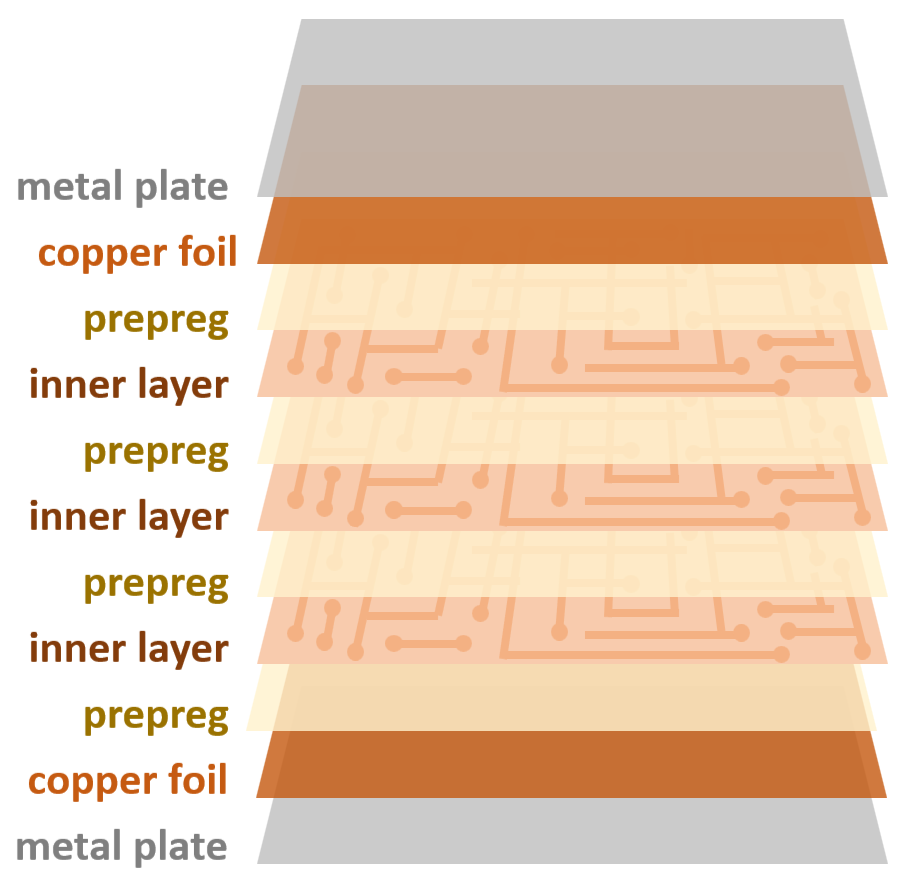
All the inner layers produced previously are assembled together during this process step. Inner layers are stacked on top of one another by placing a prepreg sheet in between two layers. Prepreg sheet plays the role of a glue.
4.1. Oxidation
The first sub-step is inner layer copper oxidation to prevent its corrosion and to improve adherence with prepreg sheets. To do so, inner layers are cleaned, microetched, and the oxide layer is applied.
4.2. Stacking
Then, all inner layers are stacked using prepreg sheets as a glue in between all inner layers. Two steel sheets are used (one on top and one on the bottom) to protect the copper foil layers from damage. These two panels are further taken out of the stack. The stacking-up step is crucial to obtain good quality multilayer PCBs.
4.3. Lamination
This step bonds together the different sheets stacked-up previously. The stack is hot-pressed at specific temperatures to melt the resin on each prepreg sheet. Depending on the materials of the panel, the temperature and pressure parameters are adjusted to reach the desired specifications of the panel.
4.4. Cooling
Then, the stack goes through a cool-press to prevent any panel deformation.
4.5. Drilling position checking
This step is important to align the inner layer patterns with outer layer ones. In this step, X-rays are used to identify the position of the wanted drilling positions that are hidden by the multilayer stack and that may have shifted a bit during the heat-press due to material deformation.
4.6. Edge routing
During this step the excess of copper all around the panel is cutted and the waste is saved for recycling.
4.7. Edge milling
Removal of the rough edges.
4.8. Visual checking
A visual checking is performed to see if the lamination has beeen correctly performed.
5. Drilling
The drilling process consists of drilling holes that can have several purposes: connecting electrically all the layers, attaching components to the PCB (solder through holes), and aligning the PCB with the final product.
5.1. Drilling a location hole
New tooling holes are created to have visible drilling references to align the panel during the next steps of the process.
5.2. Inserting pins
The panel is placed on top of a base plate to prevent drilling into the machine. The panel is fixed inserting pins into the tooling holes created previously.
5.3. Drilling holes
Holes are drilled controlling the speed and the feeds to avoid any material damage and poor hole quality.
5.4. Inspection
An inspection is performed to check if holes placement and quality meet the specifications.
6. Electroless copper deposition
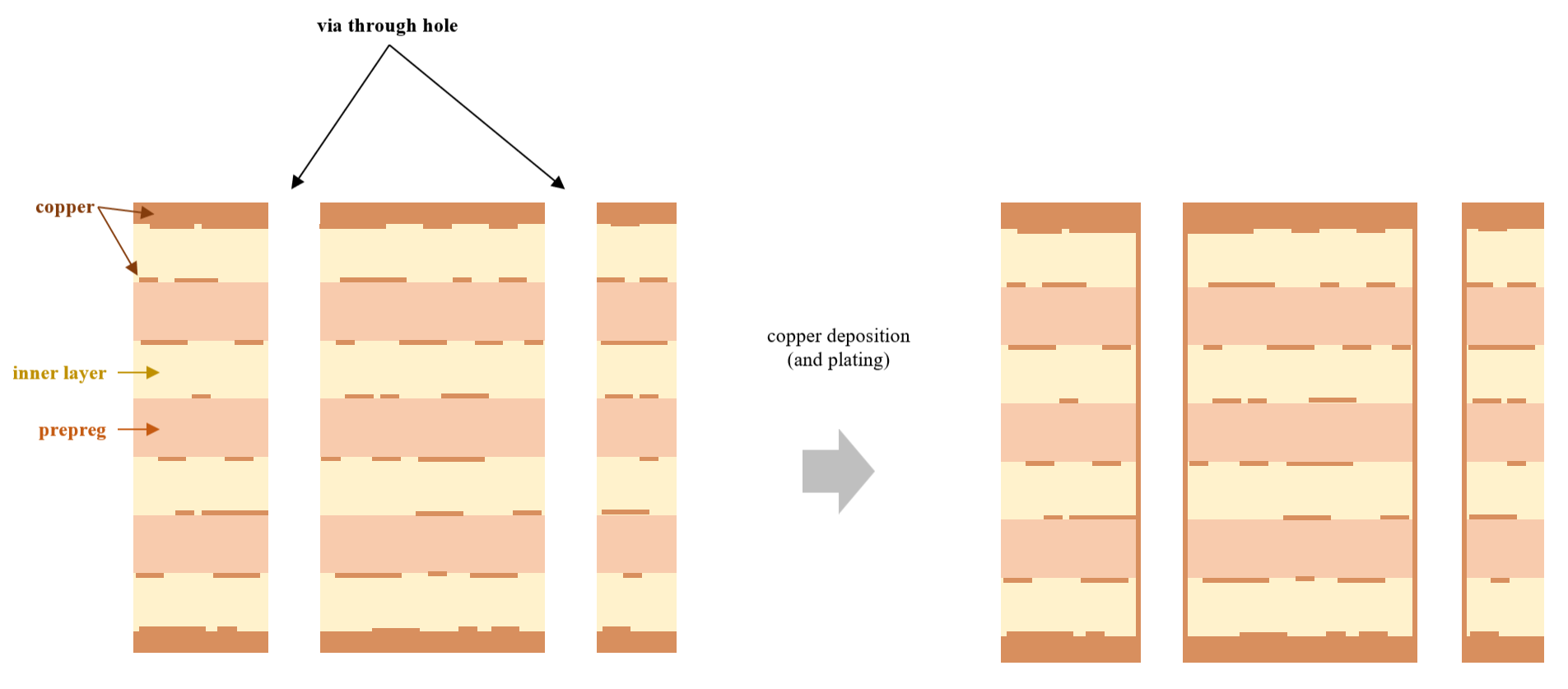
Copper needs to be deposited inside holes to ensure layer electrical connection with the rest of the board. To do so, the electroless copper deposition method is used because of its good deposition quality on non-metallic surfaces. Only a small thickness is deposited with this method, the desired thickness will be obtained further in the process flow.
6.1. Cleaning
The first step is to chemically clean the holes of any drilling residue. The board is immersed in the cleaning solution, rinsed, and dried.
6.2. Activation
The surface is then activated, meaning slightly etched, to enhance the copper deposition.
6.3. Copper deposition
Then, the whole panel is immersed in a chemical solution to deposit copper everywhere on the panel and inside holes. The thickness of deposited copper is about 1µm.
7. Plating (optional)
A thicker layer of copper (about 5-8µm) may be needed to ensure the required conduction properties of the final product. To do so, a galvanic (electrolytic) copper deposition step is added and done vertically.
- Panels are cleaned with acid and rinsed to have a clean surface during deposition.
- The panel is then connected to a cathode and immersed in a solution that is connected to an anode. When applying a current, the copper cations move in the solution to reach the panel: copper is deposited all over the panel surface.
-
8. Back-drilling (optional)
The back-drilling consists of removing parts of the holes plating for signal integrity.
-
9. Outer layer imaging
9.1. Image transfer
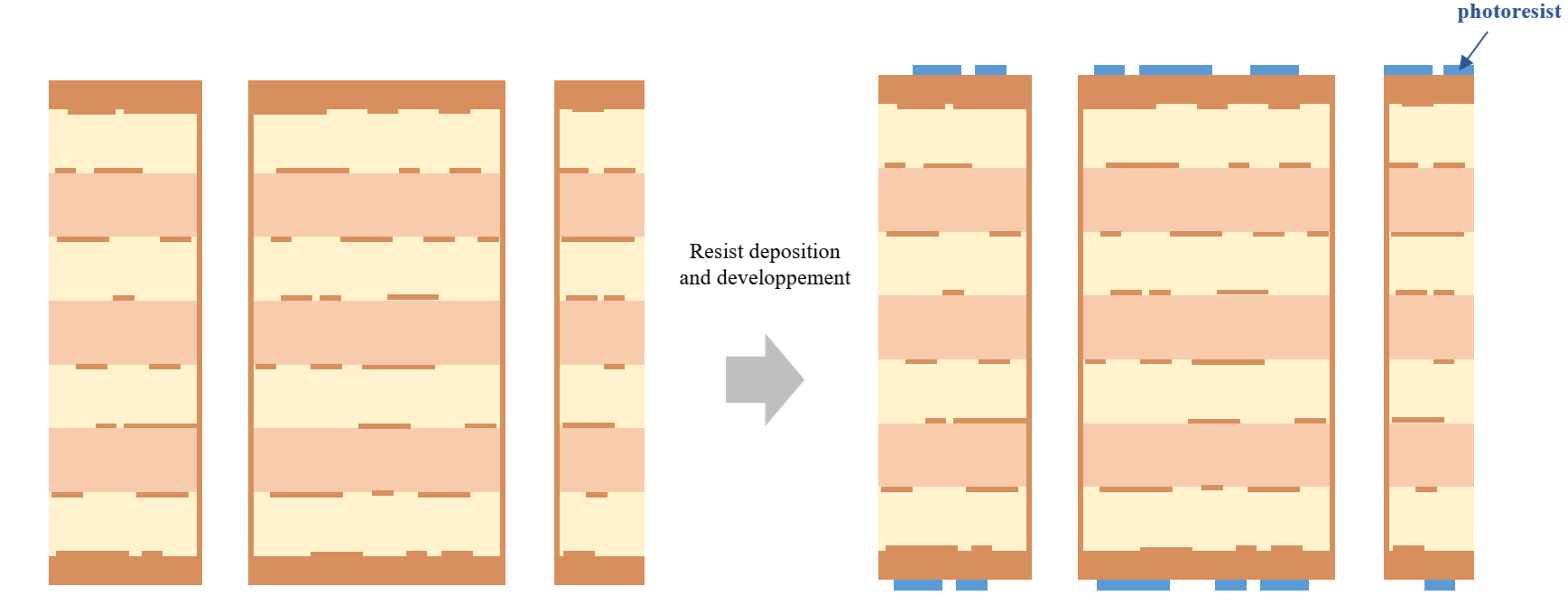
This step is focused on transferring the outer layer pattern on the board to deliver the functionality of the device. The same method as for the inner layer imaging is used (photosensitive film, mask, and UV light). However, in the inner layer imaging process, the exposed parts were the electrical pattern (the pattern is protected during the following steps), whereas in the outer layer all the surface of the panel is exposed except for the electrical pattern (in the next step additional copper will be added only on the electrical pattern). Two methods can be used: laser direct imaging (no mask needed), outworks or film and exposing them to UV light. It is crucial to be in a clean room environment because the exposition is very sensitive to any atmosphere change.
9.2. Development
Then the unwanted photoresist is taken out during the developing step, just like the inner layer developing step. The panel is immersed in a chemical solution that reacts with the unexposed photoresist. The panel is then rinsed to remove any remaining solution composed of chemicals and dissolved photoresist.
10. Plating
10.1. Copper deposition
Once the electrical pattern of the outer layer is outlined by the photoresist, an additional copper layer is added to reach the final copper thickness (about 25µm) of the outer layer and inside holes. This additional layer is added if there are some product specifications that go beyond the sanity of the PCB one. Here again the copper deposition is done by the electroplating process.
10.2. Tin deposition
Then, to protect the copper in the next process steps, a thin tin layer is deposited with the same pattern, again using the electroplating process, but with a chemical solution different from the one used for copper deposition.
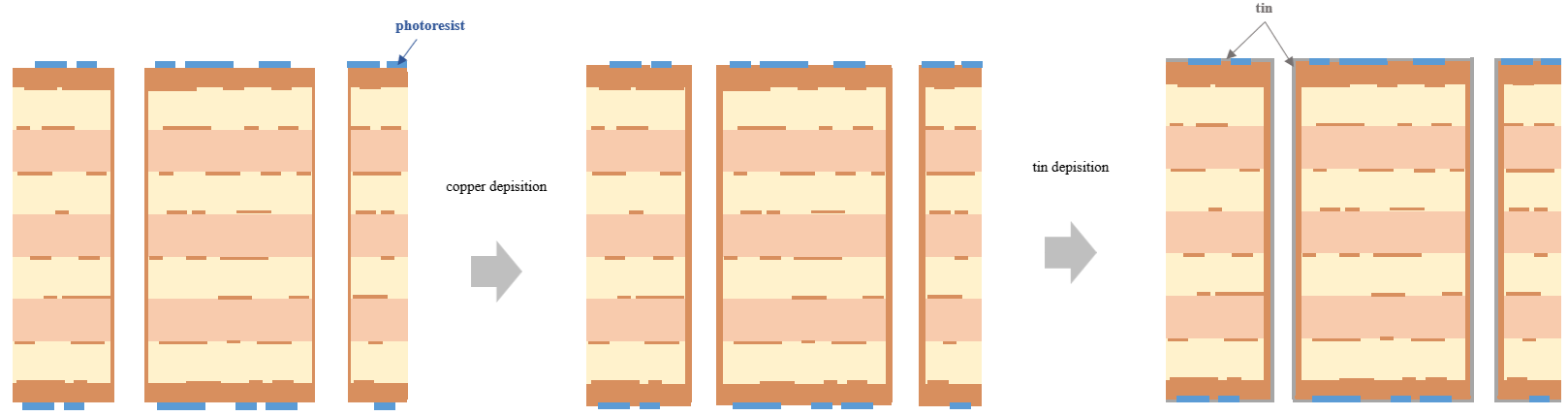
11. Outer layer etching
11.1. Stripping
In this process, all the remaining photoresist is removed from the panel, outlining the final tin-protected copper design. The photoresist is chemically removed putting the panel in the stripping solution.
11.2. Copper and tin etching
During this step, the remaining photoresist film is stripped away from the panel surface, exposing the copper and tin pattern. Then, etchants are used to remove the unwanted copper (areas where there is no tin). After this step, tin is removed from the panel (with an acid solution) as it was deposited only to protect the final outer layer pattern. To obtain a clean surface, rinsing and drying steps are performed. The PCB is now fully electrically functional.
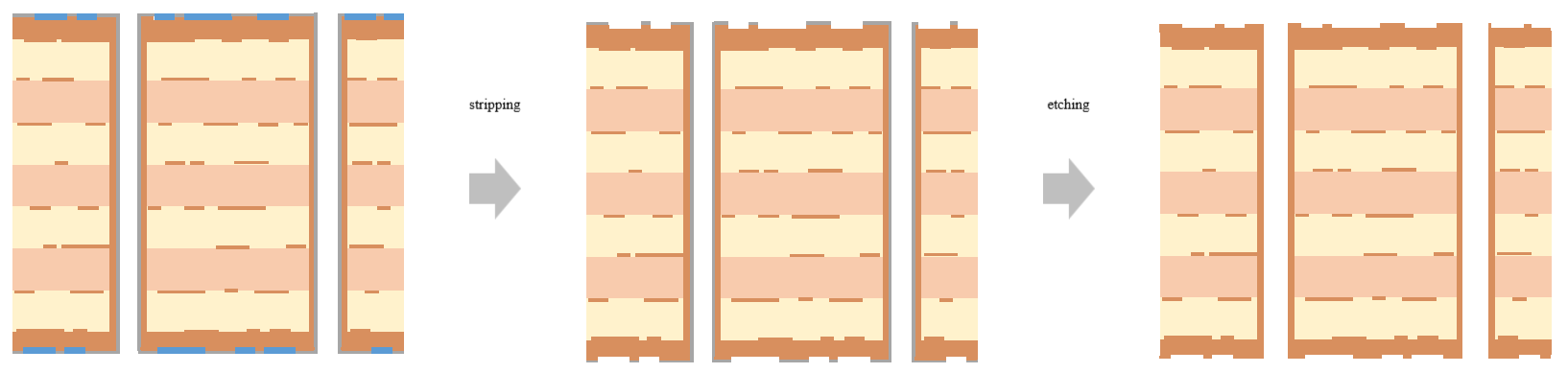
12. Optical inspection
Then the pattern obtained on the panel is scanned and compared to the designed pattern (copper pattern, spacing, etc.). The conformity of the outer layer traces are checked using optical systems.
-
13. Solder mask
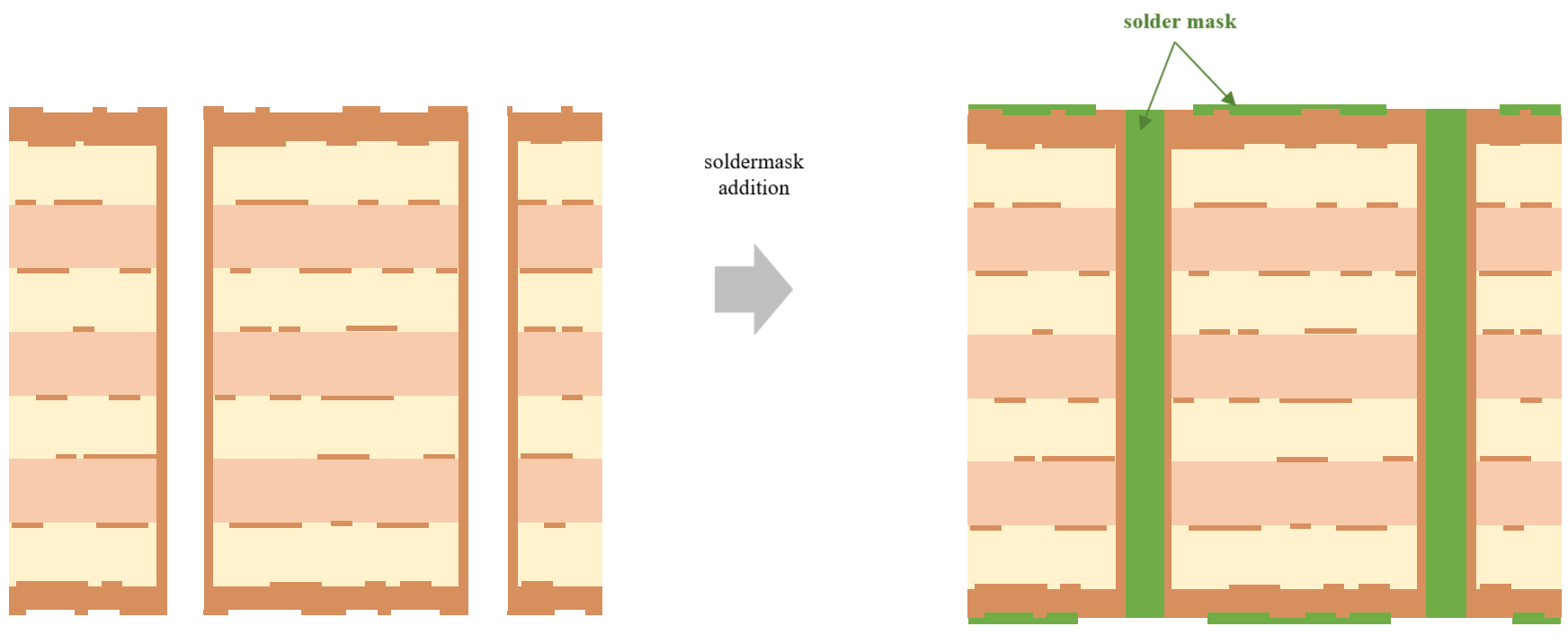
The solder mask is added to protect the metal from oxidation and the pattern from being deteriorated in the long term.
13.1. Via holes filling
The via holes need to be filled to prevent from any leakage from any chemistry being trapped into the holes during conformal coating processes. A stencil with holes matching the via holes is used: the solder mask (or via plugging ink) is scraped off the stencil so that it lays into the via holes. IPC standards exist to frame the via holes treatment.

13.2. Surface coating
The surface is covered to protect areas that needs it (connection of components do not need protection) to prevent oxidations and provide insulation. First, the surface is pumiced (mechanical brushing or chemical etching) to roughened the surface to promote adhesion of the solder mask. The panel is then rinsed and dried to prevent copper corrosion. Then the liquid solder mask is applied on bottom and top surfaces using the stray-coating or a silk screen (one side and then the panel is flipped to conduct the same process on the other side). The solder mask is then hardened during the pre-cure process so that it stays in place, forming an even layer.
13.3. Solder mask exposure
Now, the panel is ready to be exposed on both sides to UV-light through a mask: the exposure process is very similar to inner and outer layer imaging (other methods exists but this is the most common one). The goal is to make resilient only some part of the solder mask so that only the unwanted solder mask can be later removed.
13.4. Solder mask development
Now, the unwanted solder mask can be removed through the development process. The development mixture is sprayed on both sides of the panel and reacts only on the unexposed area. Panels are rinsed and dried to remove the developing solution and the unpolymerized solder mask from both surfaces.
13.5. Solder mask checking
Solder mask checking is important to verify its thickness, its adhesion to the board, registration and other elements that may influence quality or reliability.
13.6. Solder mask curing
Final curing is needed to fully set the ink. The panel goes into multiple ovens with different temperatures to obtain the full polymerization of the solder mask.
-
14. Legend
Legends are added on the panel to have visual identification of components, factory marks, etc. It can either be processed by inkjet (the ink is applied on the board and then cured to set it) or by negative solder mask printing. In the latter option, the processes are similar to the solder mask addition on the whole panel (the mask design being having the legend pattern).
15. Surface finish
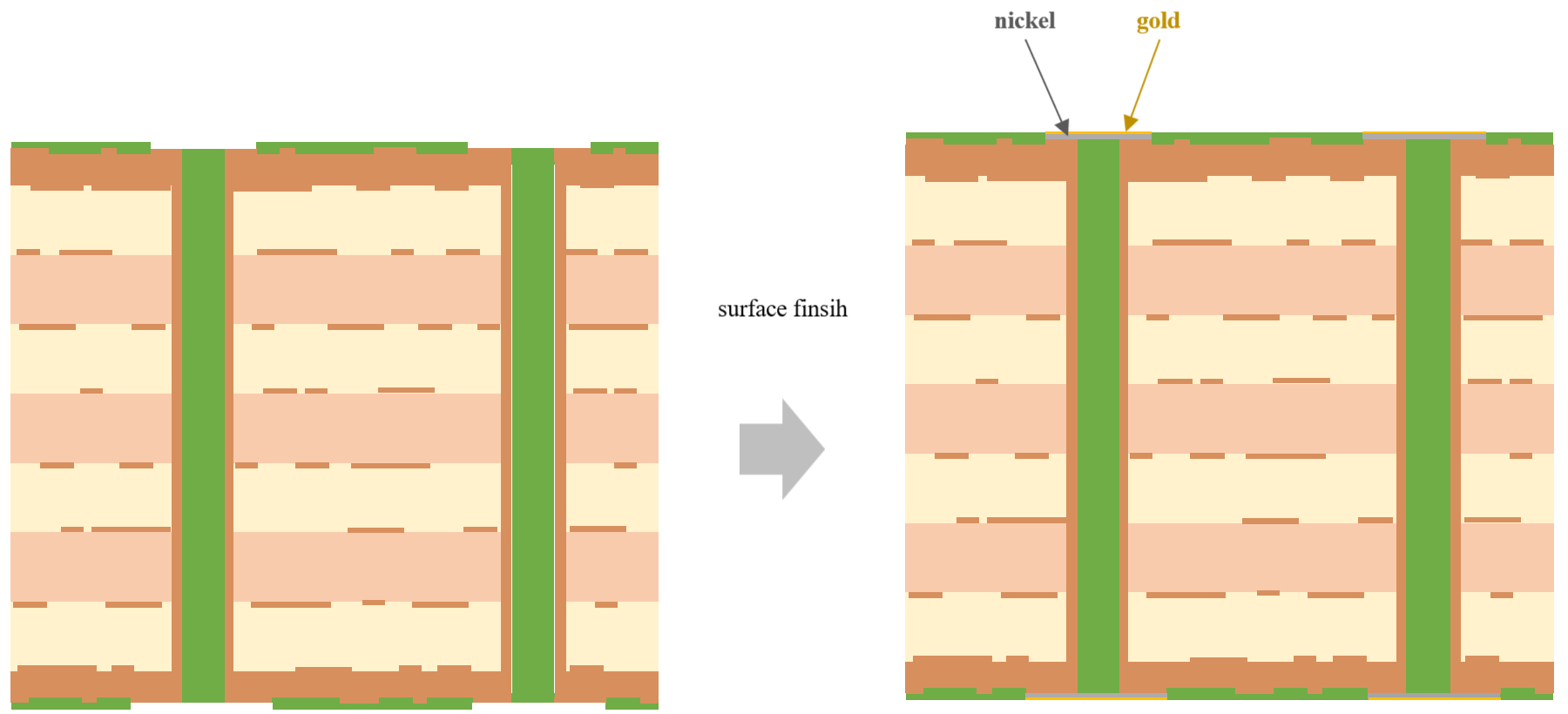
The surface finish can either be ENIG, tin immersion, or HASL. The ENIG surface finish is the most common one and tin immersion is often chosen for applications using press fit pins. This step is important because it allows customers to add components to the PCBs and prevents copper oxidation.
Electroless Nickel and Immersion Gold (ENIG)
The ENIG process is very complex. The panel goes into a series of chemical baths: a first one, an “activator”, to clean and prepare the surface for nickel deposition, a second, which consists of an electroless nickel bath, and one being an immersion gold bath. Gold is applied in a very thin layer (less than 1µm) to protect the nickel from oxidation.
Tin immersion
First, the panel undergoes a UV exposure to fully cure the solder mask (if not, tin can interact with it), then an acid solution is poured on the surface to clean it and roughened it and chemicals are rinsed out with water. Tin is applied in a very thin layer forming a bond with copper. Then, the PCB is cleaned in warm water and dried. This surface finish is more afordable compared to the ENIG process.
Hot air solder levelling (HASL)
This type of surface finish is quite common as the surface is made of a material similar to the one used to solder the components. The first step is to clean to surface. Then, the panel is put into a molted solder bath (with a controlled content of copper): the solder attach itself to copper (which are the areas where solder is needed – other copper areas are covered by the solder mask). Then hot air is blowed onto the surface to remove any excess of solder. The PCB is then cleaned to remove any remaining solder solution.
-
16. Profile
This step is performed to divide the panel in multiple pieces. For instance, usually many PCB are manufactured in one panel, and this step helps separating them from one another.
V-socre
Rotating blade on the upper and lower part of the panel creating a “V-shape” pattern where we want the separation of two PCB to be. The depth of the V-shaped lines is closely controlled. The separation itself will be performed later in the supply chain.
Routing
This is an alternative to V-score process, in which one routing blade follows an outline pattern to separate PCBs. Usually, several panels are process simultaneously by stacking them one on top of another.
-
17. Tests and inspection
17.1. Electrical test
This step is important to check if the circuit has the right connections: we are looking for any unexpected short- or open-circuit that would translate to a wrong functioning of the PCB. Two method exists to do so: the flying probe test (suitable for smaller volumes and prototypes: each electrical net is tested individually) and the bed of nail or fixture machine (suitable for large batches: all electrical nets are tested simultaneously). The 4-wire kelvin test can also be conducted, in addition of the previous one, to check net continuity and resistance.
17.2. Final inspection
Then each PCB must be inspected to check that there are no remaining defaults in their functioning. Visual checking and a wide range of other tests are performed to identify any remaining defect on the board.