
intro_oled
**This is an old revision of the document!**
Table of Contents
OLED (Organic Light Emitting Diode) screens
Types of rigidity: flexible vs. rigid OLED screens
Flexible OLED based products aren’t always bendable or foldable1). Flexibility is used to provide the display with a non-traditional form factor, but it is then bonded to a rigid glass cover in the product. e.g.: some smartphones (Samsung Galaxy Note, LG G Flex), some smartwatches (Apple Watch, LG watch urbane). 1st smartphone using AMOLED flexible tehcnology = 2013.
The difference in the manufacturing of flexible and rigid OLEDs remains in two processes steps: substrate and encapsulation (check this page for more information).
Types of matrix: active vs. passive
AMOLED (Active-Matrix OLED)
AMOLEDs include complete layers of cathode, organic components and anode. The layers of anode consist of TFT (thin film transistors) in parallel to form a matrix, which helps in switching each pixel to its on or off state as required hence, forming an image. When the pixels are not needed, they turn off or a black image on display occurs. This is least power consuming type and has quick refresh rates. They are best used in computer monitors, electronic signs or big TV screens. 2)
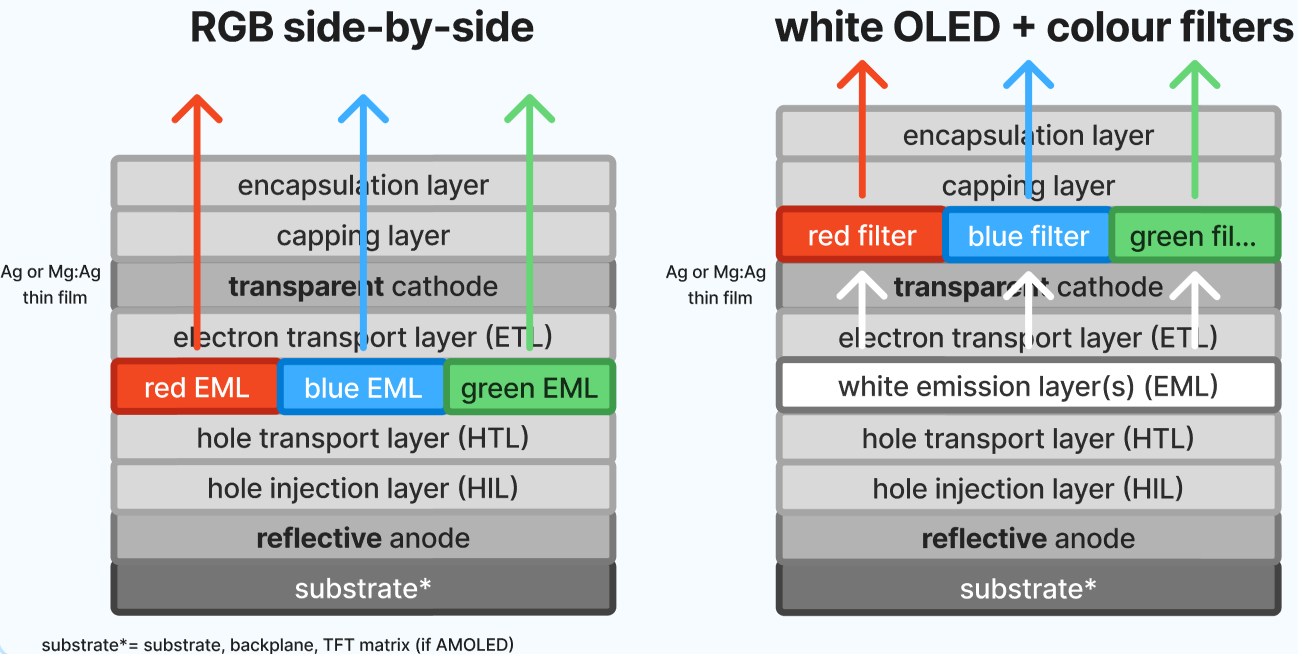
Type of emission colour
RGB side-by-side
white OLED with colour filters
blue OLED with colour converting materials
Type of stack structures: top vs. bottom emission
top emission OLED
- most used technology because less constraints on materials (no need for backplane to be transparent)
- cathode must be transparent (Ag material)
 s
s
Other OLED technologies
QD-OLED (Quantum-Dot OLED)
QD-OLED displays, which use blue OLED panels with QD color filters, started coming to market in 2023. 3)
1)
P. Samorì and V. Palermo, Flexible Carbon-based Electronics. John Wiley & Sons, 2018
2)
Q. Liu and T. Zhang, ‘Comparison between AMOLED and Traditional Display Technology and Application of AMOLED’, SID Symp. Dig. Tech. Pap., vol. 53, no. S1, pp. 1018–1021, 2022, doi: 10.1002/sdtp.16179.)
### PMOLED (Passive-Matrix OLED)
Passive matrix organic light emitting display is restricted to its passive driving method, so it is hard to make the screen size and resolution larger because the brightness is reduced with the row numbers and it needs a driver Integrated Circuit (IC) with high current supply. In order to make high resolution and large size Organic Light Emitting Display (OLED), companies invest much money to produce Active Matrix Organic Light Emitting Display (AMOLED). But compared with AMOLED, Passive Matrix Organic Light Emitting Display (PMOLED) has simple fabrication process, which does not need very complex Thin Film Transistor (TFT) backplane and also has less material cost.
They are limited in size and resolution. They have wide applications in MP3 player, cell phones displays.
((Nikhil Sain and Deepesh Sharma, Priya Choudhary, ‘A Review Paper On: Organic Light-Emitting Diode (Oled) Technology and Applications’, International Journal of Engineering Applied Sciences and Technology, Vol. 4, Issue 11, ISSN No. 2455-2143, pp. 587–591, 202
intro_oled.1775115757.txt.gz · Last modified: by sophie
Discussion